Southeast Asia’s food supply chains face ongoing challenges. Many countries in the region deal with weak logistics, storage issues, and large amounts of food waste. These problems often lead to higher costs and delays in getting food to where it’s needed.
In recent years, food tech startups in Southeast Asia have started offering new ways to handle these issues.
Startups across Singapore, Thailand, Vietnam, Indonesia, and Malaysia are improving the way food moves through the supply chain. They are helping farmers reach buyers more directly, making inventory systems more reliable, and speeding up delivery processes.
The global food technology market is projected to grow at a steady rate of 9.79% annually between 2024 and 2033.
As this growth continues, more attention is turning to how innovation can support reliable and efficient food systems. Across Southeast Asia, startups are helping bring lasting improvements to the way food supply chains work.
The Key Challenges in Southeast Asia’s Food Supply Chains

Southeast Asia’s food industry continues to face a range of supply chain problems. These challenges have opened the door for food tech startups to step in with more efficient, region-specific solutions.
1. Fragmented Distribution Networks
In many parts of Southeast Asia, especially in rural areas, transport and logistics remain underdeveloped. Farmers often rely on long chains of middlemen to get their goods to market, which slows down delivery and increases costs.
There’s often no shared system between producers, traders, and retailers, which leads to poor coordination and missed opportunities. This disjointed network makes it difficult to build a smooth and reliable food supply chain in Southeast Asia.
2. High Food Waste and Inefficiencies
Food waste is a major concern across the region. It’s estimated that around 17% of all available food in Southeast Asia is lost or wasted before it reaches consumers.
One reason is the limited availability of cold storage and temperature-controlled transport, especially for fresh and perishable items. Without proper handling, food spoils quickly, resulting in losses for suppliers and higher prices for consumers.
These inefficiencies add strain to an already fragile food system and point to the need for better food technology across the supply chain.
3. Regulatory and Compliance Barriers
Each country in the region has its own rules for food safety and handling. These differences make it difficult for businesses to operate across borders or scale up quickly. There are also gaps in how supply chain data is tracked, stored, or shared.
Without common standards, it’s hard to build trust or trace where food comes from. Improving food safety practices and creating more uniform processes will be important for long-term growth and regional trade.
How Food Tech Startups Are Addressing These Challenges
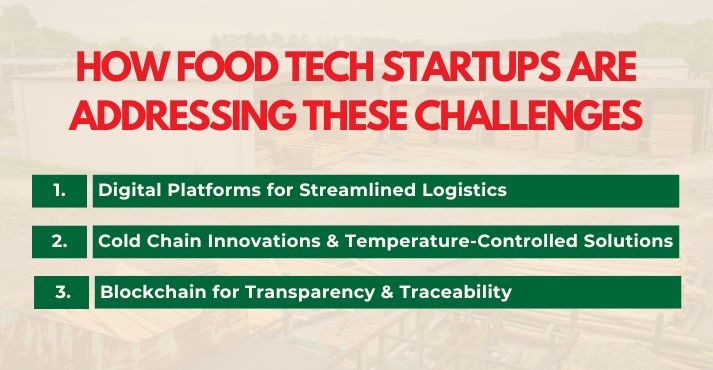
Food tech startups across Southeast Asia are finding new ways to solve the supply chain problems that have held the region back for years.
By using digital tools, smarter transport systems, and better tracking methods, these companies are helping move food more efficiently and safely.
1. Digital Platforms for Streamlined Logistics
Online platforms have made it easier for farmers, distributors, and retailers to connect without relying on multiple intermediaries.
RedMart, based in Singapore and now part of Lazada, is one example that has improved local food distribution through scheduled deliveries and real-time inventory management.
Its system supports better planning, reduces delays, and helps customers receive fresher products with more reliability.
Platforms like this are reducing communication gaps between supply chain players and helping modernize the movement of food through cities.
By improving coordination and stock management, they support stronger warehousing strategies and encourage food supply chain innovation across Southeast Asia.
2. Cold Chain Innovations and Temperature-Controlled Solutions
Keeping food fresh during transport is one of the biggest challenges in Southeast Asia’s hot and humid climate. Perishable items often spoil before reaching markets due to limited cold storage and poor handling conditions.
Coldspace, an Indonesia-based startup, addresses this problem by offering cold storage facilities, refrigerated transportation, and a logistics platform that includes shipment tracking and temperature monitoring.
In 2023, Coldspace raised $3.8 million in seed funding to expand its cold chain services nationwide. By offering temperature-controlled solutions and sustainable packaging, Coldspace helps reduce spoilage and improve product quality during transit.
These improvements support smart farming and food logistics, contributing to more effective food waste management as demand for fresh produce and seafood continues to rise in urban centers.
3. Blockchain for Transparency and Traceability
Consumers and retailers want to know where their food comes from, how it was handled, and whether it meets safety standards. Blockchain offers a way to track food at every step.
Bext360, a company specializing in coffee supply chain management, uses blockchain to document the entire process, from harvest to payment. Their system allows growers and buyers to verify quality, origin, and timelines through digital records.
In Southeast Asia, startups like EMURGO Trace have partnered with farming groups in Indonesia to build similar traceability systems. This kind of food traceability and blockchain approach supports stronger food safety practices and helps reduce fraud, especially in exports.
Notable Food Tech Startups Driving Change in Southeast Asia
The startups mentioned below are introducing supply chain solutions that improve delivery, sourcing, and local farming, reinforcing resilience and sustainability.
1. Foodpanda
Foodpanda, headquartered in Singapore and operating across 11 Southeast Asian markets, has expanded digital food distribution platforms by combining grocery and meal deliveries with advanced logistics.
Its micro-fulfilment centres, known as Pandamarts, use automation and demand-based inventory to ensure products are in stock close to customers.
Despite exiting Thailand in May 2025 to focus on profitable markets, Foodpanda continues to build a resilient supply chain with data-driven deliveries, in-app tracking, and strategic partnerships with local chains and home-based cooks.
2. AgFunder
Although based in the US, AgFunder supports Asia’s food tech growth through targeted investments in agri-tech and precision agriculture startups.
Its Asia Pacific AgriFoodTech Investment Report shows that agrifoodtech startups in the region raised $4.2 billion by October 2024, marking a 38% increase from the previous year.
AgFunder also runs the GROW Impact Accelerator in Singapore, working with early-stage companies focused on automation, soil health, food loss, and aquaculture innovation.
These investments help build startup-driven supply chain solutions and support the development of food sustainability technology across the region’s agriculture and food sectors.
3. iFarm
iFarm, founded in Helsinki and active in Indonesia and beyond, brings vertical farming systems to urban settings. The startup installs container farms and micro-farms, offering 24/7 controlled growth of herbs, leafy greens, and microgreens.
It has managed to reduce setup costs by about 28%, making its systems more accessible. In Bali’s Nuanu community, iFarm is building a high-tech farm to supply local retailers and serve as a model for urban food production.
These initiatives combine food-tech supply chains with sustainable local agriculture through vertical farming innovation.
Government Initiatives and Industry Support for Food Tech Startups

Governments across Southeast Asia are providing financial support, infrastructure, and regulatory backing to help food tech startups strengthen supply chains and improve food systems.
1. Singapore’s Government Support for Food Tech
Singapore’s 30 by 30 initiative aims to produce 30% of the country’s nutritional needs locally by 2030. This effort has encouraged investment in agri-food innovation and startup development.
Through agencies like the Singapore Food Agency and Enterprise Singapore, the government offers grants, research collaborations, and pilot spaces.
In 2024, SGD 40 million was committed to food production technologies, urban farming, and sustainable protein development.
These initiatives promote innovation in logistics technology in food, especially in urban agriculture and transport systems that require precision and control.
2. Thailand’s Investment in Agri-Tech Solutions
Thailand continues to invest in agri-tech solutions as part of its long-term modernization plan under Thailand 4.0.
Since 2020, the Ministry of Agriculture and Cooperatives has rolled out TraceThai, a digital tracking system covering the entire agrifood supply chain, including organic produce.
It works alongside 77 provincial Agritech and Innovation Centres that have shared over 700 technologies with more than 8,500 farmers. This national effort improves traceability and efficiency across farming, storage, and delivery systems.
3. ASEAN’s Role in Supporting Regional Food Tech Growth
ASEAN is working to align food safety and supply chain standards across its member states.
The ASEAN-JICA Food Value Chain Development Project, launched in early 2024, focuses on improving cold chain systems, food handling protocols, and traceability for seafood and fresh produce.
These efforts encourage cooperation among member countries and help create consistent systems for processing, storing, and transporting food across Southeast Asia.
The Future of Food Tech Startups in Southeast Asia

Food tech startups in Southeast Asia are beginning to focus on long-term solutions that address land use, production efficiency, and environmental pressure. These efforts are changing the way food is grown, processed, and distributed across the region.
1. Smart Agriculture and Vertical Farming
In dense urban areas, land for traditional farming is limited. Vertical farming offers an alternative by using stacked layers in indoor spaces to grow vegetables with reduced land and water requirements.
In Singapore, companies like Sustenir and Archisen have built climate-controlled facilities that supply supermarkets with locally grown produce throughout the year. These farms reduce transport time and help improve food quality and freshness.
This model represents ongoing food-tech innovation in Southeast Asia, especially in cities where space is scarce and import dependence is high.
2. AI and Automation in Food Manufacturing and Logistics
Startups are also improving efficiency in production and delivery. In food factories, automation systems are helping manage packaging, labeling, and quality checks. Logistics platforms use data to forecast demand and adjust supply levels in real time.
These efforts support food manufacturing optimization by helping reduce waste, avoid overstocking, and lower costs across processing and transport.
3. Sustainability and Circular Economy Models
Reducing waste is another area where food tech startups are making significant progress. Some collect unsold or surplus food from markets and turn it into animal feed or compost. Others focus on reusable containers or low-impact packaging to reduce plastic use.
These ideas are not just about reducing impact, but they also help cut costs and build supply chains that are better prepared for rising resource challenges.
Conclusion
Food tech startups are changing how food moves across Southeast Asia, addressing long-standing issues such as fragmented logistics, food waste, and uneven safety standards.
These companies are improving supply chains through smarter farming, automation, and traceability systems.
Governments and industry groups are also providing support through funding, research programs, and regional cooperation. From vertical farming to data-driven processing, innovations are helping businesses produce and deliver food more efficiently.
For food manufacturers, distributors, and logistics providers, now is the time to explore how technology can improve operations, reduce costs, and support long-term sustainability.
Staying competitive means looking for new ways to improve what already works, and finding better systems for what doesn’t. The opportunity is here to strengthen every step of the supply chain.